
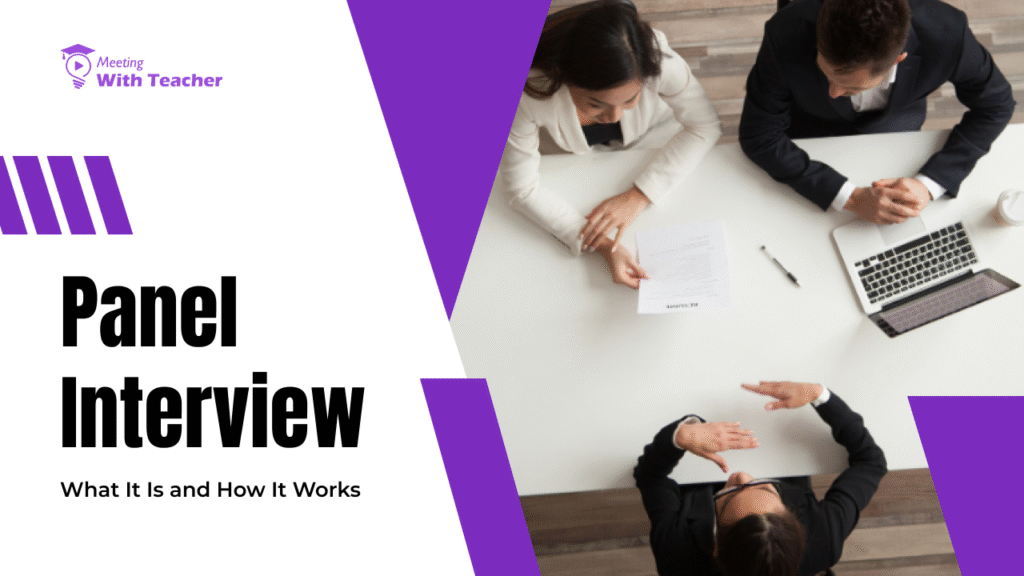
You get an interview email. Instead of one person, there will be three. Maybe four. All in the same room. It is how we define a panel interview.
So, what is a panel interview in simple words?
A panel interview is a type of interview where several interviewers, like a group of HRs and someone from the team you’re interviewing for, get together to meet with one candidate at the same time in one room. These different entities of the team judge different aspects of the candidate to decide whether it is the best fit for the position or not.
You’re still the focus, but each person is looking for something different typical panel might include:
- The hiring manager is checking if you can handle the role
- Someone from HR is looking at cultural fit
- A teammate is assessing your skills and how you work with others
Companies use this format because it saves time, gives them a broader view of you, and helps reduce individual bias.
In this guide, you’ll see:
- How a panel interview works from start to finish
- Why do employers choose this method
- How to prepare so you walk in ready, not nervous
How is a Panel Interview Different From a Group Interview?
Both Panel interview and Group Interview may sound the same; students often confuse them and use them interchangeably. But there is a difference between the two; they are basically two different interview models. Each with its purpose and criteria.
Here is how they differ from each other.
Definition of a panel interview
The panel interview is a type of interview where different employers within an organization, like hiring managers, HR, or a supervisor, evaluate a candidate for a specific role. The employers may be from different departments within the same organisation to gauge different perspectives of the employee for the position.
Instead of holding different sessions to test different traits and skills of the employee, in the panel interview format, all the comprehensive assessment is done at once. Like the skillset of the employee for the position, and personality traits, etc.
- One candidate faces multiple interviewers at the same time
- The focus is entirely on you
- Each interviewer assesses you from their perspective
In a group interview:
A group interview is different from a panel interview; it is a type of interview or an interview model where one or more employers are there to interview more than one employee at the same time. It is suitable in a situation where an organisation wants to get much in less time.
This type of interview is helpful when employers want to judge how a single candidate can stand out from the rest, by their communication skill in the group, their problem-solving ability, and confidence.
- Multiple candidates are interviewed together in the same session
- The employer observes how you interact with others
- The focus is on teamwork, communication, and leadership in a shared setting
So the main difference is that, in a panel interview format, you’re the one facing multiple employers and answering different questions as per their domain. In a group interview, you share the spotlight with other candidates.
But moving forward, we will only be discussing panel interviews throughout the rest of the blog.
Panel Interview Format – How to Prepare it
Before you appear for the interview, you must know the format of a panel interview. By panel interview format, it means the questions you should expect, the different employers in the panel, what you can ask, and how you would then follow up. All these
Although different companies may have different styles, below are some very common ones in a panel interview
Typical flow of a panel interview:
Introductions
Each member of the interview panel would introduce themselves first, which would help you sort out who is in front of you and what you can expect from which one during your session.
Opening questions
You might have heard. The opening question is something that initiates a warm conversation. This is often the question, “Tell me about yourself”. Which you can answer simply by telling about what your experience is, and why they should hire you.
Role-specific questions
Since different individuals are sitting in the panel interview, each has their own domain area to ask you about. One may focus on your technical expertise, while the other is to judge your communication and leadership skills.
Follow-up and scenario-based questions
This is how employers test how you think under pressure or solve problems, they may ask a question that may be based on real real-life problem scenario, and how you would handle it when you face it.
Your turn to ask questions
You’ll have a chance to direct thoughtful questions to the panel
Closing
The panel will explain the next step in the hiring process. This is to show transparency and a kind of proper communication in the process.
What is the duration of the panel interview?
The time a panel interview takes can vary. In many cases it runs longer than a regular one-on-one, often somewhere around forty-five minutes to an hour and a half, simply because more people are involved and each one will want to ask their own questions.
Setting:
By setting it means the actual environment of the panel interview, or in other words, a mode of an interview. It can either be in person or on-site. Or using a virtual platform for a remote interview, like Zoom or Google Meet.
There is also a hybrid panel interview model or format, where some of the employers are with you in the same room, while others join you through online channels when they are at a distance.
The overall purpose:
The format is designed to get a complete picture of you in one sitting. This means your answers need to address different perspectives, technical accuracy, cultural compatibility, and communication style.
Why Employers Rely on Panel Interviews
A panel interview is not a random decision; there are different reasons why organizations hold this type of interview. Since an interview is a vital phase for both the company and the person who applied for the position. It has to be managed based on defined standards and not based on someone’s own choice.
So a panel interview is one of those standard models that employers use due to their tangible benefits. Below are a few reasons why employers prefer panel interviewing.
Time saving
Time is an important asset for both the company and the employee; it has to be managed wisely. So, the interview in a panel format is the best option. Instead of scheduling separate interview sessions with HR, the manager, and other team members. Why not all meet at once, in one room, one decision? It saves time for every individual involved in the interview.
Different opinions for one candidate at once
All the experts, like HR, managers, and Directors, can have different opinions at the same time regarding an employee. It helps a lot in transparent decision-making. For instance, one person may ask about experience, while the other at the same time looks for the communication skills of the employee. This is a kind of coherence and clarity.
More fair than one-on-one
It is a much better approach than one interview. In that case, only one person is there and deciding about the overall session. In the panel interview structure, there are multiple people involved, giving feedback. It lowers the chance of personal bias.
Good for high authority roles
The panel interviewing model is the best fit when the company requires a person for a leadership position, collaboration, and cross-team work. If a role connects with different departments, it makes sense for people from each side to be part of the process.
This is what an interview with a panel differs from other. This model is more applicable, especially in big companies or for roles that involve more than just one skill set.
But our real concern is how you can prepare yourself for this kind of interview. let’s move to what you came here for: how to prepare for a panel interview so you don’t freeze or fumble when it’s your turn. For better understand of other types of interview you can look for different resources on credible sites.
Now It’s Time to Prepare for Your Next Panel Interview Session
Reading about panel interviews is one thing. But you also need to picture yourself in that room, answering questions from different people.
Many students confuse panel interviews with one-to-one or group formats. They’re not the same. Once you get that, preparing becomes easier. So how do you get ready?
Here is a simple approach to follow
Know your panel before you appear in the interview
One of the important aspects to keep in mind is the understanding of who will be there in the interview panel. A good practise is to ask the recruiters if you think is possible, the other way is to search out the company’s website or even LinkedIn page to know better who is there for which position. By doing so, you will be more confident and not hesitant on the interview day.
Study the role and job description
You should carefully read what the job or the role requires, and you must prepare yourself according to that. You can include your experience and how it will help in the current role when you join. Always align your expertise to what the job requires.
Make proper Eye contact
Body language plays an important role in your hiring decision. When they ask their first question, don’t panic or hesitate. Make proper eye contact at your first impression. This keeps everyone involved and shows confidence
Don’t forget to carry all the relevant Documents
Bring extra copies of your resume for each panel member. If your work can be shown, carry a portfolio or relevant samples
Ask Questions Back
If you think you have a chance to ask questions back to the interview panelist, you can ask one or two questions in a way that shows your interest in the role, and adds an extra mark in the hiring process.
Follow Up
To show more professionalism and interest in the role you applied for. It is a good gesture to send a thank-you email to the panel within 24 hours. Mention something specific discussed with each person to make your message personal
Put the Theory into Action Before Your Panel Interview
Reading tips and strategies about an interview is one thing, and putting them into action is another. If you’ve read this blog so far, you might be thinking, “Where can I put all the theory into practice?”
If you think so, you’ve almost got half done. There are certain online platforms, like Meeting with Teacher, which you can use to prepare for real real-time panel interview session. This platform has been one of the favorites among students, which provides you with an atmosphere where you feel like you’re sitting in an actual interview setting.
Wrapping Up
Panel interviews can seem a bit much when you first think about them. More people. More questions. More room to feel under pressure. But once you understand the flow and prepare for it, the whole thing becomes easier to handle.
Keep these in mind before you walk in:
- Know who’s going to be there
- Match your examples to the job description
- Carry the documents or samples you need
- Body language is a vital tool, so keep it steady and formal
- A formal follow-up within 24 hours can make you stand out in the crowd
Finally, the panel interview is not something to memorise; instead, it is to put everything into practice. The panel just wants to see how you think, how you work, and how you might fit with the team. If you can show that clearly, you’ve done what you need to do.
But still, if reading blogs doesn’t work for you, and you think something practical could help, then you already know where to go. And that’s an online platform to practise a panel interview before appearing physically in the company you’ve applied to.