
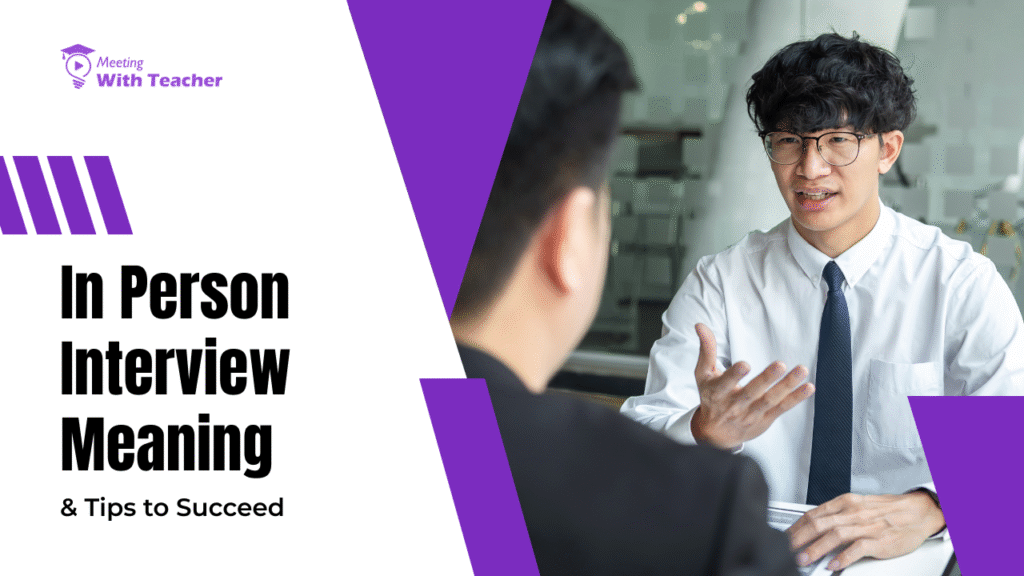
Job hunting is very stressful, especially for fresh graduates who are aspiring to start their careers. But getting a job in a reputable company cannot happen without clearing an in-person interview. The in person interview means simply a meeting where you and the employer are in the same room. Unlike virtual calls, meeting in person lets them see your body language, communication style, and confidence. Here, the recruiter will see if you are fit for the role or not.
It’s your chance to connect with the employer during the hiring process. And the right preparation can help you nail your face-to-face interview. This guide has in-person interview tips to crack your next in-person interview, but let’s see first what is in-person interview means.
In-Person Interview Meaning:
It is a meeting between a job applicant and an employer. During the physical interview, the candidate and the hr are present in the same venue. Unlike a phone or video interview, a face to face interview gives both sides the chance to know each other. It is one of the oldest and most trusted ways to hire. During an in-person interview, a job seeker is judged according to their body language and cultural fit.
Is It Important To Give An In-Person Interview?
Since the COVID-19 pandemic era, telephone interviews and online discussions have become very common. And to be honest, every one of us feels comfortable while doing everything in our bed. But in reality, the best way to find a job is to give an in-person interview at any company.
But why do recruiters prefer an in-person interview to find if you are the right person for the job or not? There is a quote by Oprah Winfrey that “Great communication begins with connection.“Which means until and unless you are able to connect with the person, your communication is not successful. And this cannot happen without meeting someone in person.
In this interview, a hiring manager will score you by your body language, facial expressions, and your skills. Typically, a recruiter will see how you talk and connect with them. And that this is important when we have to understand the emotions and attitudes of people during our conversation
So, what is an in-person interview? It is a series of questions asked when you go to the company’s office to meet the interviewer directly. You tell the recruiter about your experience and skills. This interview process reveals whether you have the required qualifications to fit the role or not.
Why Employers Prefer In-Person Interviews To Recruit A Candidate?
We must understand what we’re communicating and how it is being interpreted by the other person. Because communication is not limited to words only. This fact was earlier explained by Albert Mehrabian, A Professor of Psychology at the University of California. He started to study how people interpret emotions when verbal and non-verbal cues conflict. In 1971, he compiled his research work as Communication Theory. He concluded that only 7% of meaning is conveyed through spoken words, while 38% comes from tone of voice and 55% from body language. Scientists state this theory as the 7-38-55 rule.
A simple conclusion of this theory is that communication is not limited to our words. It includes our dialogues and body language also. And this is the reason why recruiters prefer to conduct an in person interview over a phone interview.
Many companies still choose an in-person interview because it:
- Shows how you behave in real situations.
- Helps judge your communication skills and confidence.
- It establishes trust with the hiring manager more quickly than virtual meetings.
- Shows the workplace culture within the company before accepting an offer.
Types of In Person Interviews
Understanding the in-person interview meaning also means that you should know the different formats:
One-on-One:
It happens between one interviewer and one candidate. The recruiter will ask questions about the job he is supposed to do during the job. For example, if you are applying for the role of a writer, then the recruiter might ask that how you conduct research before writing. In one-on-one interviews, you can also be asked to complete a task regarding your role. Like you can be asked to write a brief article for the role of a writer.
Panel:
It is a scheduled interview with several experts speaking to you together. In a panel interview, every person will ask questions according to their expertise. These interviews happen for roles involving collaboration with cross-functional teams. You are asked about ways to collaborate with different teams. For example, if you are applying for the role of a social media manager, then how will you devise a strategy to communicate with the graphic design team.
Sequential:
A sequential interview is basically a series of back-to-back chats with different people from the company. You might start with the hiring manager, then meet a few team members, and maybe even other department heads. Each person looks at you from their own angle — one might test your skills, another checks how well you’d fit in with the team, and someone else might focus on your communication style. All of this can occur in a single day. Or they may occur on separate days. And yes, it often works best as an in-person interview, where you can leave a positive impression.
Task-Based or Technical:
In this interview, your skills are tested for the job role you have applied for. You are asked about technical questions related to your field. The interviewers may give you a trial task to complete. After the completion of the task, the interviewer judges if you are a good fit for the job on the basis of your score.
How to Ace an Interview In Person With The Employer?
Your resume has passed the ATS test. The HR called you and scheduled your in-person interview with the team. Now you are thinking about how to ace an in-person interview? Here are in-person interview tips to get through the interview process with confidence.
1. Do Your Research (Seriously, Don’t Skip This)
The first question in your job interview that a hiring manager asks is that “What do you know about us?” If you’re not ready, all you can say is “I noticed your website”. And this does not show your enthusiasm for the role.
Instead of going blank for the interview, look into the company’s past. Read the latest news articles and press releases related to them. Analyse trends in the industry they are working in and who they are competing in the market. Your investigation suggests that you are genuinely interested in the firm.
It also gives you information to back your interview answers. Take a look on hiring platforms like LinkedIn to know who will be interviewing you. You can make an initial contact with the hiring team and give them a brief introduction about yourself. Maybe you can share an alma mater or a hobby with them. Through these little connections, you can give non-verbal cues to them that you actually desire the job role.
2. Practice Your Answers
The next steps would be to practice communication. But you cannot predict every interview question. However, you can guess a few of them, like:
- Tell me about yourself
- Why do you wish to work for this organization?
- What are your salary expectations from the company?
To respond to these questions, think about your previous accomplishments. Quote how your skills can bring benefit to the company. Explain the gaps in your work history with personal achievements you have made during this time.
3. Tell Your Experience In the form of Stories
One of my favorite tips for an in person interview is to answer with stories instead of just facts. For example, you should not say that “I’m good at problem-solving,”. But you can talk about that time when a project was made successful with your efforts.
Use the STAR method:
- Situation: Talk about the situation
- Task: Talk about the solutions of the problem.
- Action – what you actually did
- Result – the positive outcome you achieved
Stories stay in human minds far longer time. Especially when they are communiacted with confidence and good body language.
4. Make a List of Questions?
Here’s a secret: the end of the interview is just as important as the beginning. The interviewer always asks the candidate if they have a question for them or not. This is the moment where you know more about the people with whom you are going to work.
Don’t waste it on “What’s the salary?” (that can come later in the recruitment process). Instead, use this time to ask:
What are the biggest challenges in his role?
What are the factors to measure the growth of an employee?
What is the team culture?.
]This shows ypur professionalism and respect. And plus it signals that you’re thinking about how you’d fit and contribute towards the growth of the organization.
5. Dress Like You Already Belong There
In any interview, your clothing is everything. It sends a message even before you say a word. Match your outfit to the company culture. But remember to show but professionalism and respect towards the organization. Prepare your suite the night before your interview. Because you don’t want to appear in a wrinkled shirt during your one-on-one interview.
6. Plan Your Route So You’re Not “That Late Person”
There is a famous quote that your first impression is your last one. And guess what, punctuality sets the pace of your interview. Take the nearest route. You should arrive 10-15 minutes ahead of your in-person interview. After entering the venue get comfortable and revise your questions.
7. Set Your Morning Up for Success
On the day of your in-person interview. Start your day with exercise and have a cup of coffee. Review your talking points until you are called. Do not memorize them word-by-word. But retain the stories you want to bring up.
That way, you can walk in the interview process with confidence
The best in person interview tips aren’t complicated. It is just about being well prepared. Research well about your role and the company. Show professionalism and respect. Build rapport with the employer. Use non-verbal cues to answer the questions. You can also adopt a full interview template to prepare more effectively.
What Are The Mistakes to Avoid In Person Interview?
We think that we know what an in person interview looks like, right?. It’s just to show up, answer questions, and leave with a smile. But honestly, there are little things that can trip you up and cost you the job. If you don’t look our for these, an in-person interview which should be an “opportunity,” can turn into a “regret” forever.
Let’s break down the mistakes 90% of people make…
- Arriving Late
There isnothing other than being late that kills the first impression. All your confidence drains in a second when you walk into the interview room after the allocated time. The interviewer, waiting for you, gives a second thought to your skills very quickly. Thus, being late is a big no. But you can be late due to traffic or weather…right? So what to do in this case? To avoid casting a negative impression, just call or message the recruiter very early. You need to show professionalism and respect for their time so that you can leave a positive impression on the recruiter.
- Getting Distracted Mid-Conversation
Remember, an interview in person is between you and the employer. You need to focus and avoid all types of distractions till the end. Avoid using your phone or doing useless stuff in the room. This type of behavior demonstrates to the employer that you have no interest in the position. - Avoiding Clarifying Questions
During an in person interview, nobody is expects you to know the answer of every question. Even Albert Einstein did not know everything. Remember you need to show that want to learn and adapt to the growing needs of the role. If an interview question is causing confusion mind, you can then say “can you explain a bit more? But is you will stay quiet, it will show you that you are not prepared well. In reality, asking clarifying questions often makes you stand out. - Common Candidate Slip-Ups
Even when you know what an in person interview is, nerves sometimes take over. A few quick don’ts:
- Don’t bash past employers (red flag!).
- Don’t show up without your resume or required documents.
- Don’t walk in knowing nothing about the company.
- Don’t avoid eye contact as it shows that you don’t have the right skills for the role.
An in-person interview is your chance to show your skills. Thus being prepared and aware of these small mistakes can help you clear your in person interview. If you take anything from this — treat the meeting like it really matters, because it does. And if you want to know how to ace an interview in person, start by avoiding these rookie mistakes.
In-Person Interview vs Online Interview? What’s The Difference
When deciding between an in person or in-person interview and a virtual one:
- In Person — Best for strong first impressions, checking cultural fit, and building personal trust
- Online — Best for early screening or remote positions
5 Tips for a Successful In-Person Interview
Walking into an in-person interview room comes with fear and excitement. You’ve got your resume ready, but once you sit down, it’s no longer about the paper — it’s about you. And honestly, the smallest things can tip the scale just as much as your biggest achievements.
- Start With Connection
An interview in person isn’t just a checklist of skills. It’s a conversation with the recruiter where he will assess if you are a good match for the company or not. Use the interviewer’s name when addressing their questions. Respond by peering them in the eye. Don’t feel shy about sharing your experience through small talk and stories. This brief conversation can completely alter the energy. You will not be treated as a normal candidate who is forgotten. But as someone, you will be remembered. - Be Professional, Not Robotic
Remember, you are sitting in front of experienced professionals who are judging your strengths and weaknesses. So, be approachable but avoid being casual. Use industry-specific terminology, such as if you are applying for the role of a social media manager, you should know about Conversion rates, Engagement, etc. Keep your talking professional. If you are answering a tough question, answer it using your learning experiences. It shows maturity — and trust me, hiring managers notice that. - Silence Is Okay
Many people used to think silence was deadly in an interview. But pausing before answering any question is a good tactic. It shows you’re thoughtful. Its fine that you take a breath, think for a second, and then answer. - Read the Room
In an in-person interview, you are judged according to your body language. After you enter the room, sit down and get comfortable with the environment. Don’t react on any minor convenience you face during your inteerview. If the interviewer is not satisfied with your answer you can ask. “Would you like me to explain in detail?” If they’re nodding in your answers, it means you are on the right track. These non-verbal cues give you instant feedback from the interviewer. - Show Real Enthusiasm
Keep one thing in your mind that your enthusiasm will decide if you are fit for the role or not. You might have got shortlisted because of your role, but if you are not a culture fit, you might can rejected instantly. Your willingness will show that tyou are ready to work every person in a company. After the review, appreciate the interviewer for giving their time to you.
What You Should DO…?
On The Day Before Your In-Person Interview
Good in-person interview prep doesn’t end with reviewing your notes. Do yourself a favor and:
- Run through potential questions.
- Have a couple of success stories ready.
- Get proper rest (sleep is underrated).
- Print a few extra resumes — it always looks sharp to hand one over
On the Day Of Your In Person Interview
- Reach the place of your interview up 10–15 minutes early.
- Be kind to everyone.
- Stay calm, keep and confident.
- End your interview with a thank you.
After the Job Interview
Most people walk out and wait. Don’t do it. Some tips for an in person interview are:
- Send a thank-you email within 24 hours. of your conversation
- Address them with any detail from your conversation so they remember you.
- Convey to them that you are delighted about the chance.
That one small email often makes the difference between you being “just another applicant” and being the person they want to hire.
Conclusion
The in person interview means a face-to-face meeting with your recruiter. He evaluates whether or not you are qualified for the position. It is an important step in the hiring process. Because you are judged beyond your resume. With good preparation, you can increase your chances of getting your dream job.
FAQs About In-Person Interviews
What is in person interview?
It’s a meeting where you and the employer are in the same location. The recruiter asks some interview questions from you and you have to answer them according to your expertise.
What is the difference between in person and online interviews?
An in person interview happens face-to-face. On the other hand, an online interview takes place on a video call. Many hiring managers use platforms like Calendly to schedule an online interview. This session is then conducted on online tools like Google Meet and Zoom.
How To Dress For an in person interview?
You should opt for business attire. For males, this means to wear a button-up shirt with a blazer and formal pants. Don’t forget to wear a tie with your suit. And for females, they can wear a long skirt in place of formal pants and pair the dress with pointed heels.
How to ace an interview in person?
Read the job description so that you know what the company demands from you. Read about the company online. Prepare some guess questions so that you are prepared in advance. And if you are unable to feel confident, you can use tools like AI Mock Interview to prepare your questins in front of an expert.
Why employers conduct in-person interviews?
It helps see the candidate’s suitability for the role. They assess the following attributes of a person
- Communication Skills
- Expertise in the role
- Body Language
- Previous experience in the role